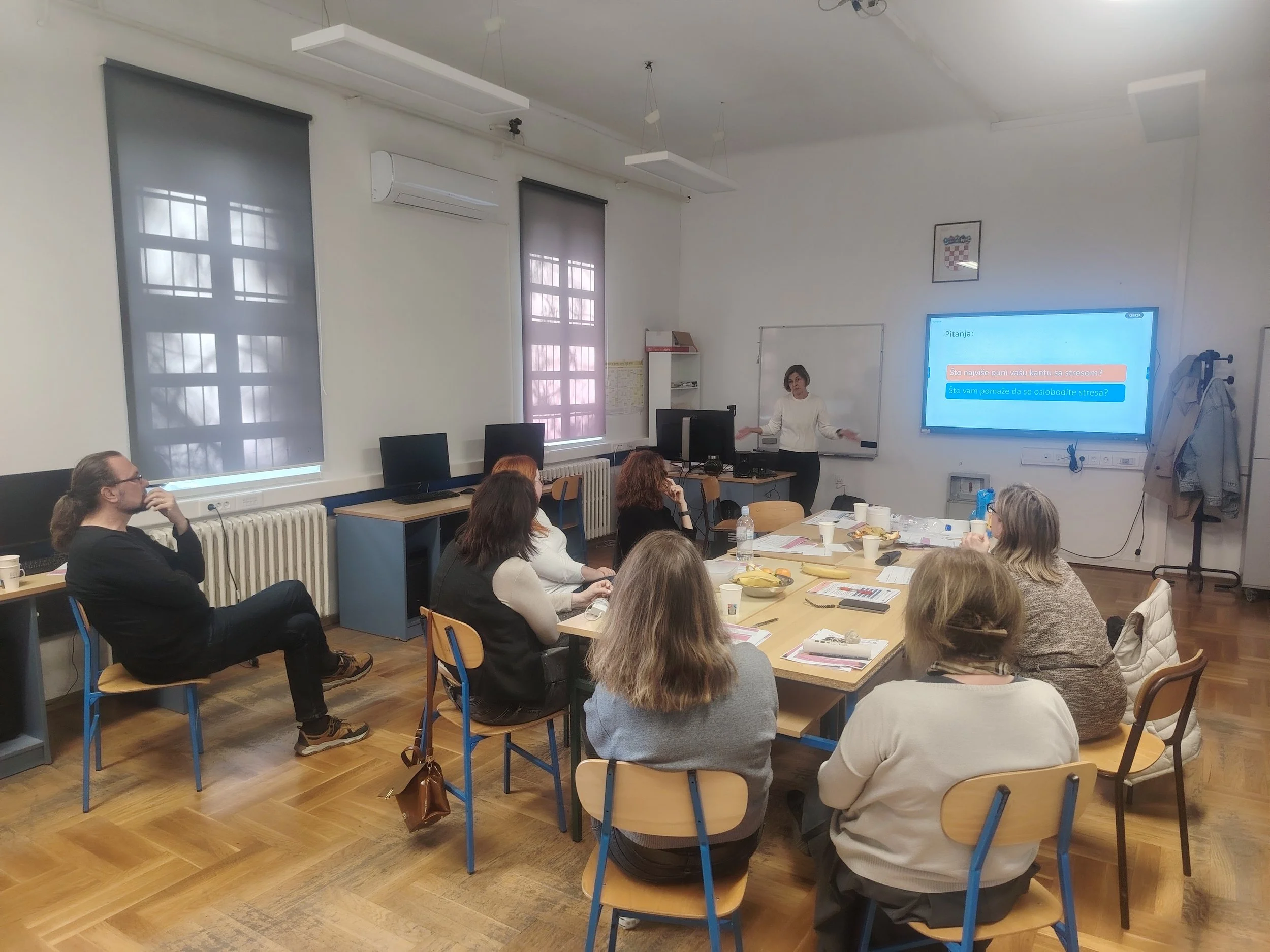
On Saturday, 14 March 2026, the classrooms of the PGŠ in Zadar became a space for exchange, reflection, and experimentation. The second in-person national training session within the Erasmus+ project Young Minds brought together teachers involved in the project and facilitators from the association Petit Philosophy, with a shared goal of preparing for what comes next, bringing mental health workshops into real classrooms.
The session was led collaboratively by two teachers from PGŠ Zadar and two representatives of Petit Philosophy, creating a balance between lived classroom experience and the broader framework of the project. From the very beginning, the atmosphere was open and participatory. This was not a lecture, but a working space.
The first part of the day was dedicated to planning. Teachers worked on developing their action plans, thinking concretely about how they will implement mental health workshops in their schools. They reflected on their goals, the lesson plans they would use, the classes they would work with, and how to present and integrate these activities within their school environments. Alongside this, they explored how to approach the “How to Make a Short Film” workshop, an element that connects creative expression with discussions on mental health.
As the session progressed, the focus shifted from planning to practice. Teachers stepped into the role of facilitators and delivered mock lessons, while their colleagues and facilitators became students. What followed was not a simple rehearsal. Teachers adapted the lesson plans, brought in their own teaching experiences, and in some cases prepared additional materials such as presentations to support their work.
It became clear that the purpose was not to follow the lesson plans step by step, but to understand how to create a space in which students can think, question, and reflect. The classroom was imagined, but the questions and approaches felt very real.
After each lesson, the group gathered for discussion. These moments often lasted longer than planned, not because of poor time management, but because of genuine engagement. Teachers shared what they had seen, what worked, what felt uncertain, and how they imagined these activities unfolding with their own students.
One of the strongest threads throughout the day was the question of how to approach mental health in the classroom. There were many “what if” scenarios, drawn from personal experience, from colleagues, or from situations that might arise. These conversations revealed both hesitation and responsibility, but also a clear commitment. Teachers were not looking for simple answers. They were trying to find ways to approach the topic thoughtfully and responsibly.
By the end of the session, what stood out was not only what had been learned, but how it had been learned. The training became a shared space of mutual learning. Teachers learned from each other, facilitators learned from teachers, and the lesson plans themselves were shaped through this exchange.
The session in Zadar was not just a step in the project timeline. It was a moment in which ideas were tested, doubts were voiced, and confidence slowly began to take shape.